

The Biological Compass: How Negative Feedback Loops Keep Us Sane
Hard Truths, Soft Boundaries — When Science Meets Ethics


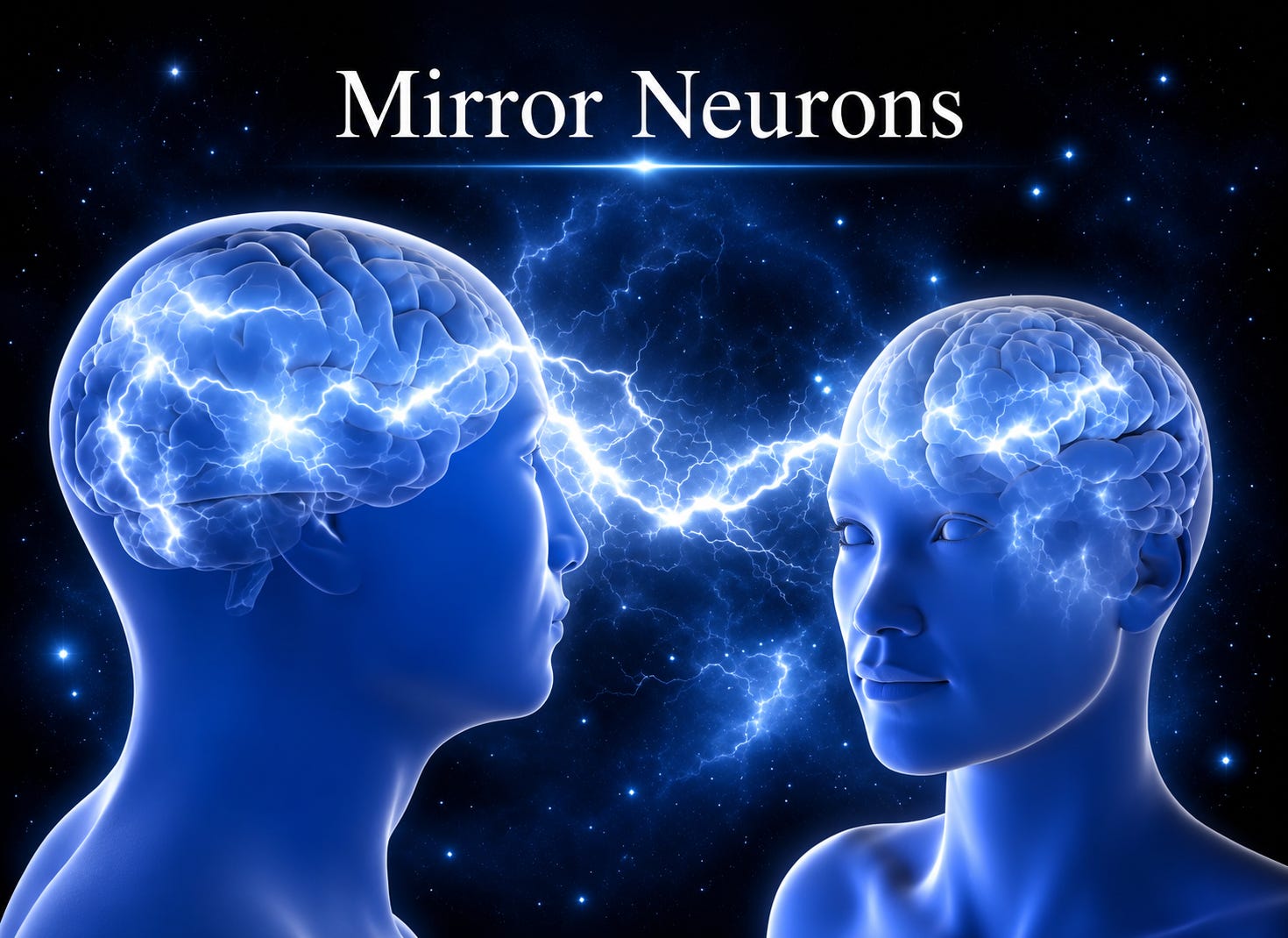
Have you ever wondered how we are capable of feeling another person’s pain or joy without exchanging a single word with them?
No, this is not some spiritual magic or ungraspable mysticism; one of the most compelling biological explanations lies within a network in our brains: mirror neurons — a mechanism still actively researched, yet widely seen as foundational to how we connect.
Mirror neurons act as the vital sensory input for deeper, cognitive empathy by registering immediate physical resonance, functioning similarly to the brain's negative feedback loops.
While mirror neurons themselves do not calculate correction—they reflexively register and mirror motor actions and immediate physical resonance—they serve as the vital sensory input for our internal feedback systems.
If you see someone smile, or conversely, if you watch someone suffer after a brutal, below-the-belt blow, these neurons fire reflexively inside your own brain.
But make no mistake: mirror neurons do not perfectly copy the other person’s complex emotional psyche, such as grief.
It is not about feeling a hair’s breadth exactly what the other person feels. It simply triggers a reflexive, often uncomfortable internal tension and motor resonance within us—a tiny biological signal that reminds us of the reality of the outside world.
Mirror neurons are widely understood to be a core pillar of our capacity for empathy — and thus, one of the quiet guardians of our sanity.
They force us to stay grounded in reality and to constantly calibrate our own behavior based on the raw, unfiltered feedback of our environment. They are responsible for keeping us flesh-and-blood, feeling human beings, rather than cold, isolated algorithms.
But what happens when you simply excise this fine biological compass from the system?
Have you ever wondered why some of history’s most infamous rulers and certain individuals among the world’s wealthiest billionaires run on the exact same software glitch?
The explanation is far more entertaining and human: as a direct side effect of limitless power and wealth, common sense simply tends to quietly leave the system.
Imagine buying a car, but you rip out the brake pedal, disconnect the dashboard, and paint the windshield entirely black so you cannot see the road.
How far do you think you’ll get? ... To the next bend? ... Or perhaps a little further, a mere matter of luck, but the bottom line is that the final outcome will not be very fortunate.
There exists a small circle: heirs of old oligarch dynasties, modern tech gurus, and the Davos elite — who are likely sitting inside exactly this custom-tuned luxury car.
The Biological and Systems Engineering Short-Circuit
The trouble begins for some people when you have two hundred billion dollars — at that point, for them, the word 'no' is permanently and irrevocably deleted from their reality.
Even at this highest echelon, a narrow spectrum exists—those rare, disciplined minds who consciously build internal brakes to compensate for the luxury vacuum—yet the system of the majority inevitably overclocks and explodes.
In cyber-security and systems engineering, there is a fundamental law: no complex machine can maintain operational stability without its negative feedback loops.
If you sever the wires that transmit error signals back to the central processor, the system loses its corrective capacity, running as an uncalibrated, open-loop mechanism that inevitably drifts into chaotic malfunction and systemic breakdown.
It does not matter how robust or expensive the physical hardware is; a system running without operational resistance is structurally doomed to failure.
Real empathy is not just a passive mirror; it is an active regulatory cycle.
True negative feedback requires the system to take this raw sensory data and use it to adjust its behavior.
When power dampens motor resonance, it effectively damages the sensor, leaving the central processor blind and unable to calculate the necessary ethical corrections.
Neurobiological research has demonstrated that unchecked power and wealth can significantly alter this hardware layer. Specifically, high social power dampens motor resonance within the mirror-neuron network, effectively silencing the neural mechanisms that map the actions and states of others.
When a billionaire systematically isolates himself from the uncomfortable resonance of reality surrounded by paid sycophants and courtiers, his cerebral cortex simply gives up its function.
With nothing to provide a natural resistance against the ego, the software eventually begins to believe that gravity, the laws of physics, and even human destinies are on its payroll.
The ruthless, direct consequence of this functional blindness is the clinical Hubris we witness in the highest circles of the world.
The Reality of Hawaii’s Secret Bunkers
And here comes the most amusing phase of this clinical hubris.
When a billionaire in a similar position has already bought everything—the media, the politicians, half a continent—he begins to get bored. His mind shifts gears, and he signs up for the role of the Almighty.
Looking down on us from behind the glass wall of a skyscraper, he does not see the global population as flesh-and-blood human beings, but as a swarm of ants inside a slightly oversized Petri dish.
A significant portion of this technocratic elite is fully convinced that he is the self-appointed Systems Administrator of humanity, whose sacred duty is to "reprogram" society.
It is no coincidence that rumors swirl about the secret blueprints of the ultra-rich. And do you know what the most terrifying part is?
Half of those rumors are true.
Certain well-known tech leaders are not building gigantic, self-sustaining, underground luxury bunkers on isolated islands in Hawaii or New Zealand with their own water purification and energy grids as a joke.
They are systems managers: they know exactly that the global apparatus they operate is unstable, and their experiment could collapse at any microsecond.
The Grand Statistical Error: The Evolution of Survival
But here lies the gigantic statistical error that the calibrated minds of the elite fail to register, even with their supercomputers.
They believe that survival during a global collapse depends entirely on the thickness of their concrete walls and the volume of their accumulated capital. But pure evolutionary statistics and history show something completely different.
Research and history suggest a striking pattern: who survives real catastrophes?
Who withstands extreme pressure?
Historical and evolutionary data suggest a striking pattern: survival rarely belongs to the completely isolated, nor does it favor those who rely solely on individual brute force.
Long-term resilience belongs to those who maintain tight-knit, collaborative loops with their environment—rarely those who cocoon themselves away, insulated from the raw demands of reality.
The luxury bunker fails not just because the hardware might break, but because it is a monument to absolute disconnection—and in a systemic collapse, an isolated component is an evolutionary dead end.
When systems collapse, natural selection instantly switches to absolute survival mode.
Those who master rapid adaptation will remain standing.
Those who are ruthlessly hardened by raw reality—the sharp-witted prisoners, who have already optimized their survival algorithms under maximum environmental constraints,
the warriors, and those resilient souls who learned to recalibrate themselves in a matter of seconds amid the dust and mudballs of daily life.
When the grid goes dark, the Hawaiian luxury bunker instantly ceases to be a sanctuary; it becomes a gilded underground coffin.
Because if the generator of these oligarchs—who fancied themselves gods—conks out, they will not know how to repair the hardware with their own two soft hands.
Outside the bunker walls, a hardened, relentless army will be waiting for them—an army whose members were shaped and made bulletproof by the very laws of survival, while the rich were busy staring at their Forbes lists.
You can buy the whole planet, but you cannot bribe the Entropy of your cells, cancer, or aging with a fat wire transfer.
In the end, Nature remains the purest and most ruthless judge, rewarding not accumulated capital, but raw adaptation and organic synthesis with the environment.
And there is no irony more merciless than when the oligarch, imagining himself a god inside his underground concrete city, realizes this:
while he successfully dampened his own mirror neurons in his sterile vacuum - permanently erasing the uncomfortable resonance of human connection - he could not delete the deeper codes of biology from the system.
Facing his own fragile mortality, he is exactly the same vulnerable, flawed, and mortal component as anyone else lying on a hospital bed.
📚 References & System Documentation
I. Neurobiology & The Empathy Scaffold
Rizzolatti, G., & Craighero, L. (2004). The mirror-neuron system. Annual Review of Neuroscience, 27(1), 169-192.
Obhi, S. S., Hogeveen, J., & Inzlicht, M. (2014). Power changes how the brain responds to others.Journal of Experimental Psychology: General, 143(2), 755-762.
II. Systems Engineering & Cybernetics
Wiener, N. (1948). Cybernetics: Or Control and Communication in the Animal and the Machine. MIT Press.
III. Evolutionary Biology & Survival Dynamics
Trivers, R. L. (1971). The evolution of reciprocal altruism. The Quarterly Review of Biology, 46(1), 35-57.
IV. Classical Literary Layouts
Coleridge, S. T. (1798). Kubla Khan; or, A Vision in a Dream: A Fragment.
🥱 i'm yawning...
The structural instinct here is strong. The cross-domain chaining (neuroscience, cybernetics, evolutionary dynamics) is doing real work, and citing Obhi et al. rather than gesturing at the concept is a good signal.
One observation on the architecture. Mirror neurons are carrying the full load of the argument, but the field has moved considerably since Rizzolatti 2004. The empathy-via-mirroring thesis is an active research question, not settled hardware specification. The piece treats it as the latter. That matters because everything downstream depends on it.
The cybernetics bridge has a related gap. "Negative feedback loop" has a precise meaning in Wiener's framework. Reflexive motor resonance is not that. The analogy is doing the work of an equivalence, and the systems engineering authority transfers without the systems engineering constraints.
The survivalism section ("who survives real catastrophes?") is an empirical question with a research literature. The answers in that literature are more granular than the piece implies.
None of this means the direction is wrong. Power reducing empathic responsiveness, isolation degrading feedback, these are real observations with real support. The gap is between the observations and the certainty of the claims built on top of them.
Tightening the falsifiability would strengthen what is already a solid engine.